

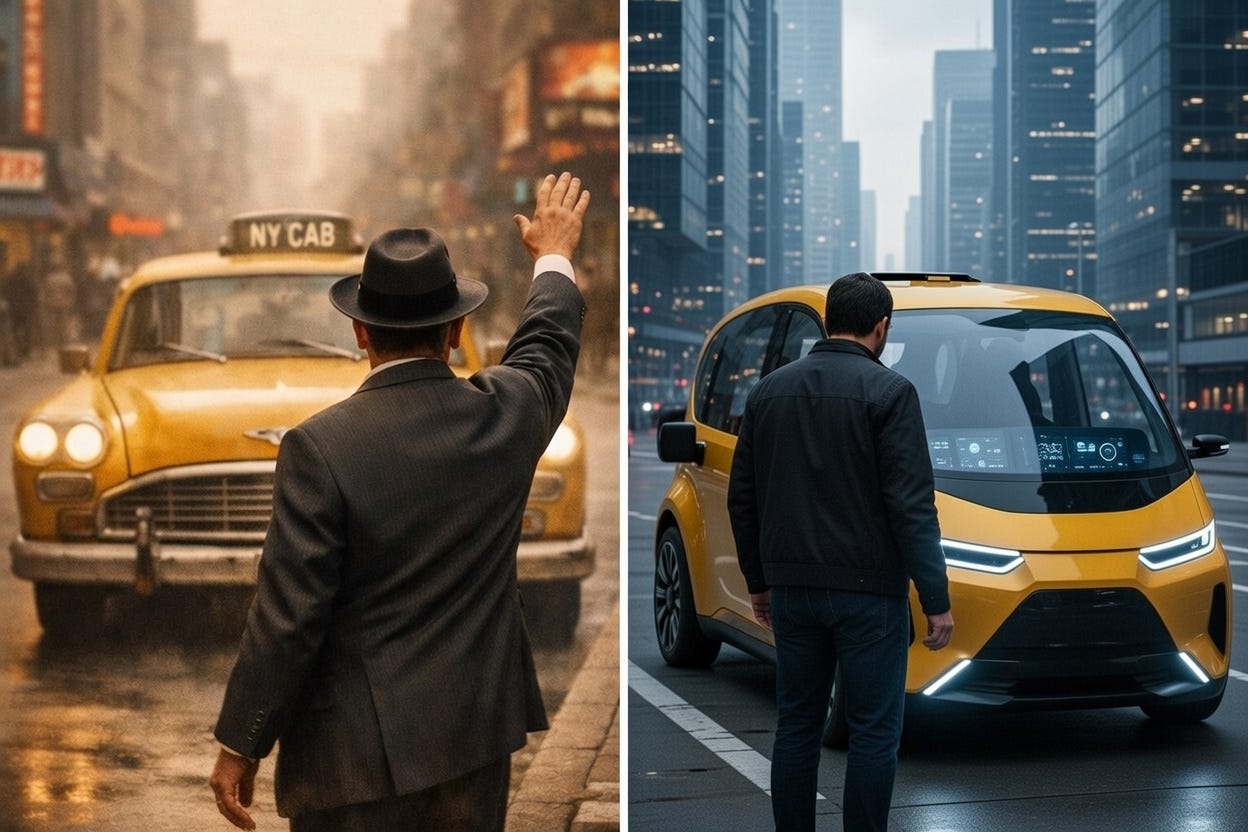
There was a time not long ago when progress felt like progress, when new things arrived without erasing the old ones, when you could still look around and see the landmarks of your old life.
The phone on the wall.
The taxi with a driver at the wheel.
Coins in your pocket and a car dashboard that didn’t resemble a cockpit.
Now, the landmarks are disappearing. All at once. All around us. And I cannot help but notice that, for the first time in my life, I sometimes look around and see nothing familiar at all.
For most of human history, every generation watched the world change slowly, layer by layer. Your childhood stayed visible in your adulthood. Your adulthood stayed visible in your old age.
If you visited your hometown at seventy, you could still point to half the things that shaped you. The little shop. The brick church. The neighbor’s house with the maple tree out front.
But not now.
This is the first generation that can live long enough to see its entire world evaporate while it is still here.
Phones are no longer phones. They listen, track, record, and predict.
Taxis no longer have drivers. Soon, not even steering wheels.
Cars arrive without a human being at all.
Conversations are no longer private.
Microphones hide in every appliance.
Money is no longer physical. It is a number in a cloud you do not control.
Maps no longer fold.
Photos no longer fade.
Birthday cards land in your inbox, not your mailbox.
And the objects that once grounded us have been replaced with glowing rectangles, floating software, and invisible systems that know our habits better than we do.
If you’re interested in how this surveillance creep is unfolding right now, see my recent piece: The AI Pin That Never Blinks.
Progress is supposed to help people live better. Progress used to feel human.
This new world is not built on familiar tools
Our world is now built on things we cannot see or touch. Invisible infrastructure. Hidden algorithms. Digital whispers. Predictive tracking. Devices that know where you have been, who you spoke with, and what you said.
This is not nostalgia speaking. It is recognition. A quiet realization that something essential has slipped away. Not the past itself, but the evidence of the past. The anchors. The reminders. The physical touchstones that told you, “You lived here. You belonged to this world.”
Now the world looks less like a home and more like a system, a dream, a hologram.
And people my age are left standing in the middle of it, asking a simple question.
Where did everything go?
We see the new things. The gadgets. The apps. The devices that talk, listen, and glow. But where are the old things? The things that reminded us of who we were? The things that tied us to a real, physical, human world?
Children today will never understand what it feels like to pick up a phone with a cord attached to the wall. To drop a coin into a payphone. To flag down a taxi in the rain. To hold a boarding pass made of paper. To tuck a photograph into a wallet. To sit on a porch and talk without wondering if something is listening.
These things were not just objects. They were rituals. They were moments that belonged to people. Not to corporations. Not to servers. Not to AI models.
People belonged to each other then.
Now, it feels like people hibernate in a digital universe, living in code and computer algorithms. And that is the quiet grief of my generation.
We are not afraid of change
We have lived through more change than any generation in history. We are afraid of erasure and looking around and seeing no trace of the world that held us.
We are afraid that the new world is not being built for human hearts at all.
Yet in all of this, there is a truth I hold onto. A truth that has guided every generation before us. A truth that cannot be erased by gadgets, algorithms, or glowing pins clipped to a shirt.
The world can vanish. But the soul does not.
The past can fade. But the truth remains.
The landmarks can crumble. But God is not shaken.
We may be strangers in this new world, but we are not orphans. And perhaps the reason the old world is disappearing is so we learn not to put our faith in the things that rust, break, or digitalize into nothing.
Maybe this vanishing world is preparing us to see the world that does not vanish.
The world that awaits us and does not need updates.
The world that will never be replaced.
The world that was promised long before any of this began.
“So we fix our eyes not on what is seen, but on what is unseen, since what is seen is temporary, but what is unseen is eternal.” 2 Corinthians 4:18
Martin Mawyer is the President of Christian Action Network, host of the “Shout Out Patriots” podcast, and author of When Evil Stops Hiding.
Follow him on Substack for more action alerts, cultural commentary, and real-world campaigns defending faith, family, and freedom.