
Meet the Munster
No, not that one. But the NIH researcher caught bringing undeclared viruses into America.

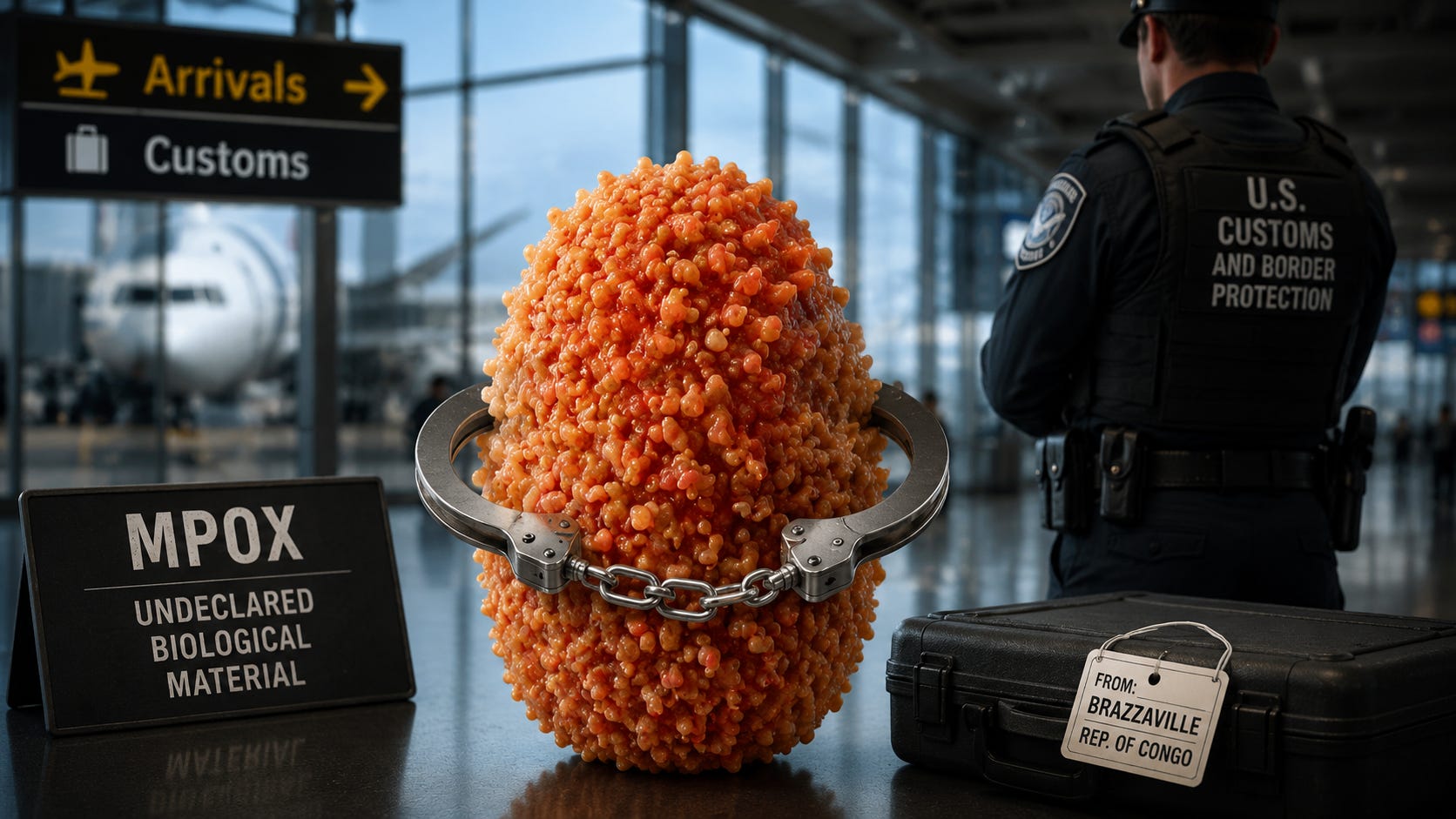
Vincent Munster got stopped at Detroit Metropolitan Airport on January 25, 2026, with a package straight out of a horror movie.
He and research fellow Claude Kwe had just flown in from Brazzaville in the Republic of Congo, where an mpox outbreak was raging. Customs officers asked about the large black plastic case the pair was hauling. Munster and Kwe claimed it held nothing but “diagnostic and testing equipment.”
Agents opened it anyway.
Inside were 113 vials stuffed into Styrofoam coolers. By June 2, the FBI had tested twenty of them. Seventeen contained deactivated mpox virus. One held the chickenpox virus. Two contained only human DNA.
Court filings later stated that the tested samples did not propagate and were assessed as inactivated, meaning the materials examined were reportedly not capable of causing infection. That distinction matters.
But what is clear is that they intentionally misled authorities about the contents of the black plastic case.
The allegation in this case is not that an outbreak was prevented at the airport, but that biological materials were allegedly transported and described in ways federal authorities say did not comply with required procedures.
The criminal complaint filed that day charged both men with conspiracy to smuggle monkeypox into the United States and with making false statements to law enforcement.
Munster serves as chief of the Virus Ecology Section at the Rocky Mountain Laboratories, a BSL-4 facility operated by the National Institute of Allergy and Infectious Diseases. His program studies how emerging viruses cross species barriers.
The work mixes dangerous field trips into active outbreak zones with high-containment lab experiments. Kwe worked under him.
The two had spent nine days in Congo chasing a circulating mpox strain and had been in touch with local scientists at the national public health lab in Brazzaville. They have co-authored at least a dozen mpox papers since 2023, half of them with Congolese colleagues.
Munster told officers the documentation for his “diagnostics” was on his laptop and that this was routine. Records later showed he had shipped biological materials before through World Courier. The vials were never declared as what they actually were.
Public reporting and congressional oversight inquiries have focused primarily on questions of authorization, disclosure, chain of custody, and biosafety compliance rather than allegations of deliberate biological harm.
But for critics of modern outbreak research, that distinction raises another concern: if transport and reporting rules become flexible in routine scientific work, where are the boundaries when urgency increases?
This is the same Munster whose lab once hosted Jun Li, a Chinese researcher who now works as an Associate Senior Virologist at the Hangzhou Center for Disease Control and Prevention in China. That fact alone does not prove a foreign plot. But it does raise the kind of questions Congress is now asking.
Was this merely a reckless shortcut by researchers who thought the rules did not apply to them? Or was it something more serious, an attempt to test whether biological materials could be moved into the United States through an open door?
Perhaps that is exactly why the House Committee on Energy and Commerce is demanding answers from NIH about foreign sample acquisition, international transport procedures, disclosure requirements, foreign research trips, and whether these researchers had permission to return with biological materials.
This case does not establish a connection to previous controversies surrounding global pathogen research. But it does raise broader questions that extend beyond a single airport inspection: how biological materials move internationally, how much oversight relies on self-reporting, and whether existing safeguards keep pace with modern outbreak science.
Before COVID-19, similar high-containment coronavirus research in China involved collecting viruses from nature, moving samples across borders, and building international networks. When something escaped or jumped, the world paid the price.
Munster’s operation follows the same script: collect from hot zones, bring materials home, maintain quiet foreign ties, and treat strict border rules as optional.
The 1960s sitcom The Munsters gave us a family of friendly monsters living quietly among normal people. This Munster is transporting deactivated death in coolers, lying to federal agents at the airport, and running a program whose daily business is moving the world’s most dangerous viruses in and out of containment.
The 113 vials in Styrofoam were not alarming because federal testing reportedly found the samples examined to be inactivated. They were alarming because of what the allegations imply.
If experienced researchers working within one of America’s highest-containment systems allegedly believed biological materials could move under inaccurate descriptions or outside required declarations, the public question becomes larger than a single airport inspection.
The concern is not whether these particular samples were dangerous.
It is whether the guardrails are strong enough to catch the next case if the samples are not.
One lab. One case. One lie at customs. Are these programs preventing or propelling the next pandemic?
Dr. Alexis “Alex” Littlefield, a former Chief of Staff for Christian Action Network, holds a PhD in International Politics and has coordinated high-profile events with congressional staff and administration officials, including assistant secretaries and agency heads. Subscribe to his personal Substack page.
 | A guest post by
|
I am reminded of a One Minute Mystery from a children's book of the same name. One of the cases involved a known international smuggler, the local border patrol, the fancy luxury car the smuggler was in the habit of driving, and the briefcase in the trunk. The briefcase was found to have a false bottom, and when border patrol agents opened it, they found three glass vials. One had beach sand, a second held molasses, and a third was full of beach glass. Nothing illegal was found, so they were forced to let the smuggler into the country. The head of the border patrol tells this story to the detective featured in the One Minute Mysteries book, and after hearing the account of this smuggler, the detective remarks on how clever the smuggler was. He was actually smuggling in the expensive cars he drove! This could be a case where they smuggle in inactivated viruses until the authorities get used to it and let them enter without a check, but this time it's fully activated viruses. And another deliberate pandemic gets started. America and other nations are being targeted by enemies who use the most subtle means of not only creating panic, but decimating entire populations. This is not a recent practice. When people were moving across the U.S. in the 19th century, if they encountered Native Americans defending their territory, the whites would take blankets that had been used by smallpox victims and not washed, and give them to the Natives. The resulting local epidemic of smallpox would then decimate entire villages, allowing the whites to pass through the land without firing a shot. Germ warfare makes taking over a country a lot easier, and less expensive. This is what we're looking at now.